
Imagine knowing exactly what your customer wants before they do. That’s no longer a marketer’s fantasy — it’s what artificial intelligence delivers today. AI in digital marketing is reshaping how businesses connect with their audience, automating routine tasks and surfacing insights into customer behavior that used to take weeks to uncover. By combining machine learning with predictive analytics, marketers can now optimize strategies in real time rather than reacting after the fact.
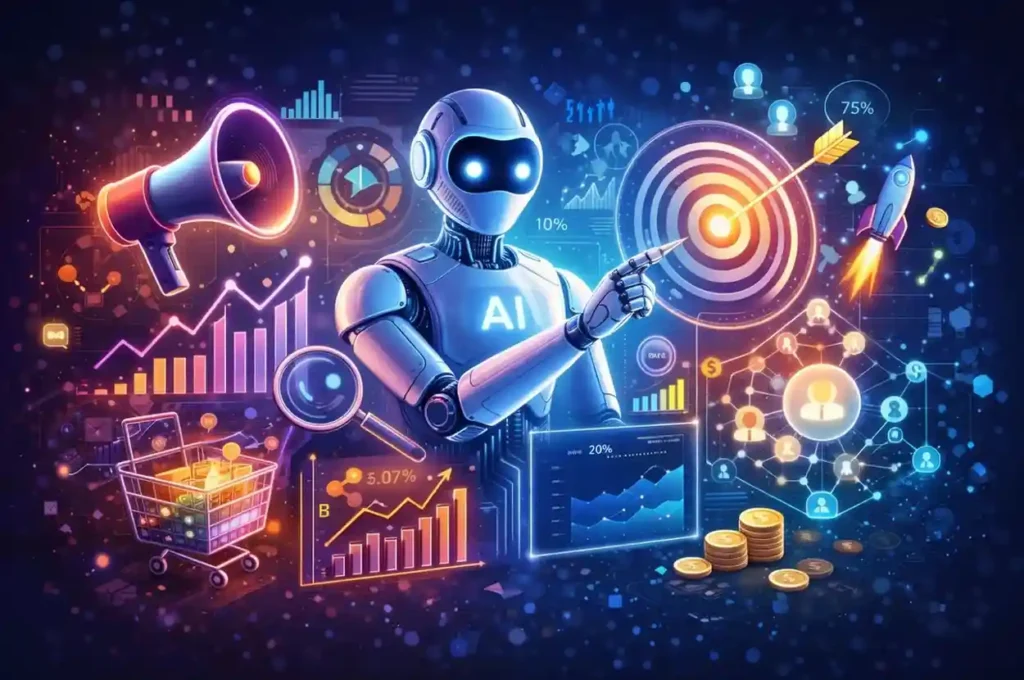
The importance of AI in marketing can’t be overstated. It helps teams make smarter, faster decisions, enhance the customer experience at every touchpoint, and ultimately drive growth while maximizing ROI.
In this guide, we’ll walk through what AI in digital marketing actually means, how to put it to work across your strategy, the tools worth knowing, and the trade-offs to weigh before you commit.
What Is AI in Digital Marketing?
AI in digital marketing refers to the use of artificial intelligence technologies to automate, optimize, and enhance marketing efforts. This includes tools that analyze data, predict consumer behavior, and personalize experiences to make campaigns more efficient and effective.
AI is changing how marketers create and deliver content, interact with customers, and measure campaign performance. With AI-driven automation, businesses can deliver personalized experiences at scale — improving engagement and conversion rates in the process. In fact, a recent industry study found that 61% of marketers consider AI the single most important tool for improving customer experience.
As the technology matures, more businesses are adopting it to stay competitive. Machine learning algorithms can now forecast trends, optimize content delivery, and deepen understanding of customer needs — leading to sharper, more confident marketing decisions.
How to Use AI in Digital Marketing
AI can be woven into nearly every part of a digital marketing strategy. Here’s where it tends to make the biggest impact:
🔹 Personalization. AI tools analyze customer data to shape personalized content, product recommendations, and email campaigns tailored to individual preferences — boosting engagement and conversions.
🔹 Chatbots and customer support. AI-powered chatbots handle customer queries in real time, delivering instant support and improving satisfaction while reducing the load on human support teams.
🔹 Predictive analytics. By analyzing historical data, AI can forecast customer behavior and emerging trends, helping marketers target more precisely and allocate resources where they’ll do the most good.
🔹 Content creation and optimization. Natural language processing (NLP) tools can generate content or help optimize existing copy for SEO — letting teams produce quality material faster.
🔹 Ad campaign optimization. AI automates bidding strategies, sharpens audience targeting, and adjusts campaigns based on real-time performance data to improve ROI.
Bringing AI into these areas streamlines your marketing operations and makes your strategy more efficient overall.
AI Digital Marketing Tools Worth Knowing
- Google Analytics — AI-powered features help marketers analyze user behavior, track site performance, and surface actionable trends automatically.
- HubSpot— Uses AI for lead scoring, email personalization, and content recommendations, automating customer interactions along the way.
- ChatGPT (OpenAI) — Generates high-quality copy for websites, blogs, ads, and social media, helping teams scale content production without sacrificing relevance.
- Hootsuite — Suggests optimal posting times, flags trending topics, and helps manage scheduling and performance tracking across platforms.
- Copy.ai — Speeds up copywriting for social posts and product descriptions while staying aligned with brand voice.
- Mailchimp — Uses predictive analytics and segmentation to optimize email performance and personalize content based on user behavior.
How to Build an AI-Driven Marketing Strategy
Turning AI into a real strategy — not just a set of tools — comes down to a few deliberate steps:
- Define your goals. Get specific about what you’re optimizing for: conversions, engagement, brand awareness. Clear goals shape everything that follows.
- Gather and analyze data. Pull customer data from every channel — social, web traffic, sales — so AI has something meaningful to learn from.
- Choose the right tools. Match tools to needs: chatbots for support, predictive analytics for optimization, personalization engines for experience.
- Implement personalization. Use machine learning to tailor content, emails, and recommendations to each user.
- Optimize campaigns in real time. Let AI adjust targeting, bidding, and creative on the fly so campaigns stay effective throughout their run.
- Measure and adjust. Track performance continuously with AI-driven analytics, and refine your approach based on what the data shows.
Pros and Cons of AI in Digital Marketing
Pros
- Increased efficiency — automates repetitive tasks so teams can focus on strategy.
- Personalized experience — tailors content and recommendations to individual customers.
- Data-driven insights — surfaces trends that inform smarter decisions.
- Real-time optimization — fine-tunes campaigns as performance data comes in.
- Cost-effectiveness — reduces operational costs while improving ROI.
Cons
- Upfront investment — software and training carry real setup costs.
- Data dependency — poor-quality data leads to poor-quality decisions.
- Complexity — some tools need specialized knowledge to use well.
- Risk of losing the human touch — over-automation can feel impersonal.
- Privacy considerations — data use must stay compliant with regulations like GDPR.
The Bottom Line
AI has undeniably transformed digital marketing — automating processes, sharpening customer experiences, and optimizing campaigns in ways that weren’t possible a few years ago. The upside is real, but so are the trade-offs, and getting the most from AI means weighing both carefully rather than adopting tools for their own sake. Businesses that understand AI’s capabilities and its limits are the ones best positioned to grow.
Ready to put AI to work in your marketing? As a online marketing specialist, I help businesses integrate AI into their strategy the right way — from personalized campaigns to data analysis and process automation. Let’s talk about how to bring the latest AI tools into your marketing and get better results for your brand. Reach out to get started.